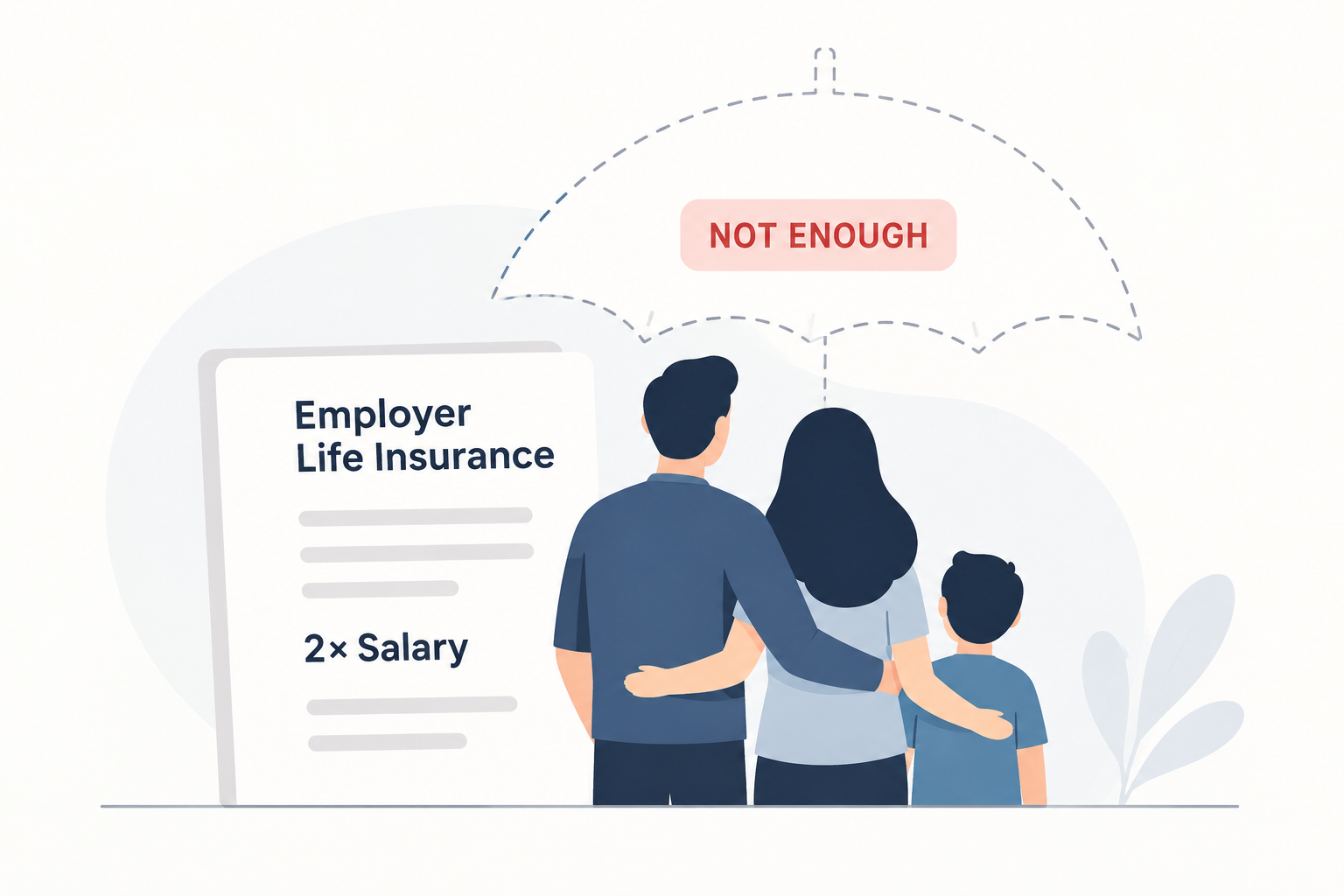
Employer-provided life insurance can feel like a complete safety net. Coverage is often included automatically with workplace benefits, so it is easy to assume your family would have enough financial protection if something happened to you.
In many cases, however, employer coverage may not be enough to replace your income or cover your family’s long-term financial needs.
Employer Coverage May Leave a Large Gap
Consider someone earning $70,000 a year with employer-provided coverage equal to twice their salary. That would provide a $140,000 death benefit.
While $140,000 may sound substantial, the money could quickly be used for expenses such as funeral costs, outstanding bills, mortgage payments, and childcare.
Life insurance is designed to help replace the financial support your income provides over many years. A relatively small employer policy may not provide enough money to cover those long-term needs.
Your Coverage Usually Depends on Your Job
Another important issue is that employer-sponsored life insurance is generally connected to your employment.
If you leave your job, are laid off, or retire, your employer-provided coverage may end. Replacing the coverage later could also become more expensive, particularly if your health has changed.
Supplemental life insurance offered through an employer may have similar limitations, and premiums can increase as you move into older age bands.
Estimate How Much Coverage You Need
A simple starting point is to estimate your coverage based on your income.
One commonly used guideline is 10 to 12 times your annual income. You can then adjust that amount based on your family’s circumstances.
You may need more coverage if you have:
- A large mortgage
- Young children
- Future education expenses
- Significant debts
- A spouse who depends heavily on your income
You may need less if your spouse has a strong income, your children are financially independent, or you already have substantial savings and investments.
After estimating the amount your family may need, subtract the coverage provided by your employer. The difference can give you a starting point for considering an individual life insurance policy.
Consider Individual Term Life Insurance
If you need additional coverage, individual term life insurance can provide protection for a specific period.
For example, a healthy 30-year-old may be able to purchase a substantial amount of 20-year term coverage at a relatively affordable monthly premium. The exact price depends on factors such as age, health, coverage amount, policy term, and insurer.
A longer term may make sense for someone who wants coverage through important financial years, such as the period when children are growing up or a mortgage is being paid off.
Employer Coverage Can Still Be Useful
This doesn’t mean you should reject employer-provided life insurance.
If your employer provides free coverage, it can be a valuable benefit. The problem is relying on it as your only life insurance protection.
Think of workplace coverage as an additional layer of protection while maintaining an individual policy that is not tied to your current employer.
Leave a Reply