
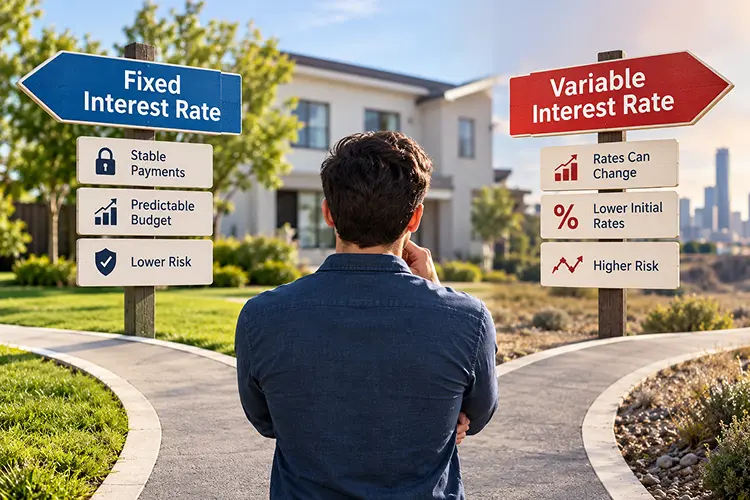
When you apply for a mortgage, personal loan, auto loan, or open a credit card, one of the most critical decisions you will make is choosing between a fixed interest rate and a variable interest rate. This choice dictates how your monthly payments behave over time, how much total interest you will pay, and how exposed you are to macroeconomic shifts.
Understanding the mechanics of both rate structures, their unique advantages, and their potential risks is essential for protecting your budget and securing the right financing for your financial goals.
What Is a Fixed Interest Rate?
A fixed interest rate is an Annual Percentage Rate (APR) that remains completely locked and constant for the entire duration of your loan term.
How It Works: Once your loan agreement is signed and finalized, the interest rate established on day one will not change, regardless of how drastically broader economic conditions, inflation, or central bank benchmark rates fluctuate.
Payment Predictability: Because your interest rate never changes, your principal and interest payment remains identical every single month. This makes long-term budgeting straightforward and eliminates the risk of sudden payment shock.
Key Benefits of Fixed Rates
Absolute Stability: You are completely shielded from rising interest rate environments. If macroeconomic benchmark rates double over the next five years, your locked rate remains untouched.
Simplified Long-Term Planning: Fixed rates are ideal for long-term financing commitments—such as 15-year or 30-year mortgages—where predictability is vital for household cash flow.
What Is a Variable Interest Rate?
A variable interest rate (sometimes called an adjustable or floating rate) is an APR that can fluctuate periodically over the life of the loan based on changes in an underlying economic benchmark, such as the U.S. Prime Rate or the Secured Overnight Financing Rate (SOFR).
How It Works: Your loan agreement establishes a starting interest rate, usually pegged to a benchmark index plus a specific lender markup (known as the margin). When the underlying benchmark rate rises or falls, your interest rate adjusts accordingly, altering your monthly payment or the amount allocated to interest.
Initial Attraction: Variable-rate products often start with lower initial interest rates compared to fixed-rate options, making them attractive for short-term borrowing or for borrowers who plan to pay off the debt quickly.
Key Risks of Variable Rates
Payment Uncertainty: If macroeconomic benchmark rates climb, your monthly payments will increase, which can strain your monthly cash flow.
Rate Caps: Most variable-rate loans include built-in protections—such as periodic rate caps (limits on how much the rate can change per adjustment) and lifetime caps (the absolute ceiling your rate can reach)—though payments can still rise significantly during aggressive rate-hiking cycles.
Fixed vs. Variable Interest Rates: Key Differences
Rate Stability: Fixed rates remain locked for the entire loan term, whereas variable rates fluctuate periodically based on market indexes.
Payment Predictability: Fixed rates offer identical monthly principal and interest payments, while variable-rate payments can rise or fall over time.
Starting Rates: Variable rates often feature lower introductory rates than fixed rates, compensating borrowers for taking on future market risk.
Ideal Time Horizon: Fixed rates are best suited for long-term borrowing where stability is paramount, whereas variable rates can work well for short-term loans or when market interest rates are projected to decline.
How to Choose the Right Rate for Your Loan
Selecting the right rate structure depends on your personal risk tolerance, current economic conditions, and how long you plan to carry the debt:
Choose a Fixed Rate If: You are securing a long-term loan (like a mortgage), prefer absolute budget predictability, or believe macroeconomic interest rates are likely to rise in the future.
Choose a Variable Rate If: You are taking out a short-term loan that you plan to pay off rapidly before rates can adjust, or if you want to secure a lower initial monthly payment and are comfortable absorbing potential future fluctuations.