
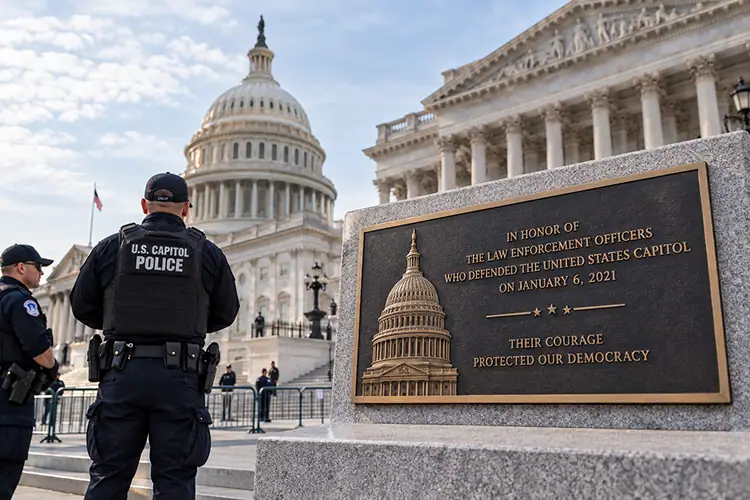
A United States federal court has officially dismissed a high-profile lawsuit brought forward by former Capitol Police officer Harry Dunn and current Metropolitan Police officer Daniel Hodges regarding the commemorative plaque honoring law enforcement who defended the U.S. Capitol on January 6, 2021.
US District Judge Dabney Friedrich granted the Architect of the Capitol's motion to dismiss the case, ruling that the plaintiffs lacked legal standing under Article III of the Constitution at the time the lawsuit was filed.
Background of the Plaque and Legal Dispute
The roots of the legal battle trace back to a congressional provision passed in 2022 directing the installation of a plaque to honor the police response during the January 6 attack. While the statutory requirement called for a permanent display listing the names of responding officers on the western front of the Capitol, the plaque faced prolonged installation delays.
Dunn and Hodges subsequently filed a civil lawsuit to compel compliance, arguing that the failure to prominently display individual names exacerbated their psychological trauma and exposure to public harassment. Although a plaque was temporarily placed in a nonpublic Senate wing area featuring a QR code instead of a full text listing, the legal challenge continued over compliance and placement demands.
The Court's Ruling on Standing
In granting the dismissal, Judge Friedrich emphasized that the officers did not satisfy the strict constitutional requirements needed to establish a concrete injury in fact directly traceable to the defendant's actions.
Lack of Jurisdiction: The court concluded it lacked jurisdiction because the plaintiffs' arguments failed to demonstrate a direct legal injury caused by the administrative delays.
Emotional Distress Claims: The ruling noted that arguments regarding emotional distress and public friction did not fulfill the rigorous legal criteria required for federal court standing.
Legal Precedent: The decision underscores the distinct boundaries required for individuals attempting to legally enforce government compliance with legislative directives.
Legal experts note that while the ruling addresses the specific procedural hurdles of the case, it closes the chapter on this particular courtroom battle over the memorial's handling.